

Muscle Stimulation Devices Market to Reach US$1,077.6 Mn by 2033 | Persistence Market Research
muscle stimulation devices market
Global muscle stimulation devices market driven by rising pain disorders, sports injuries, home care adoption, and portable rehab technologies.
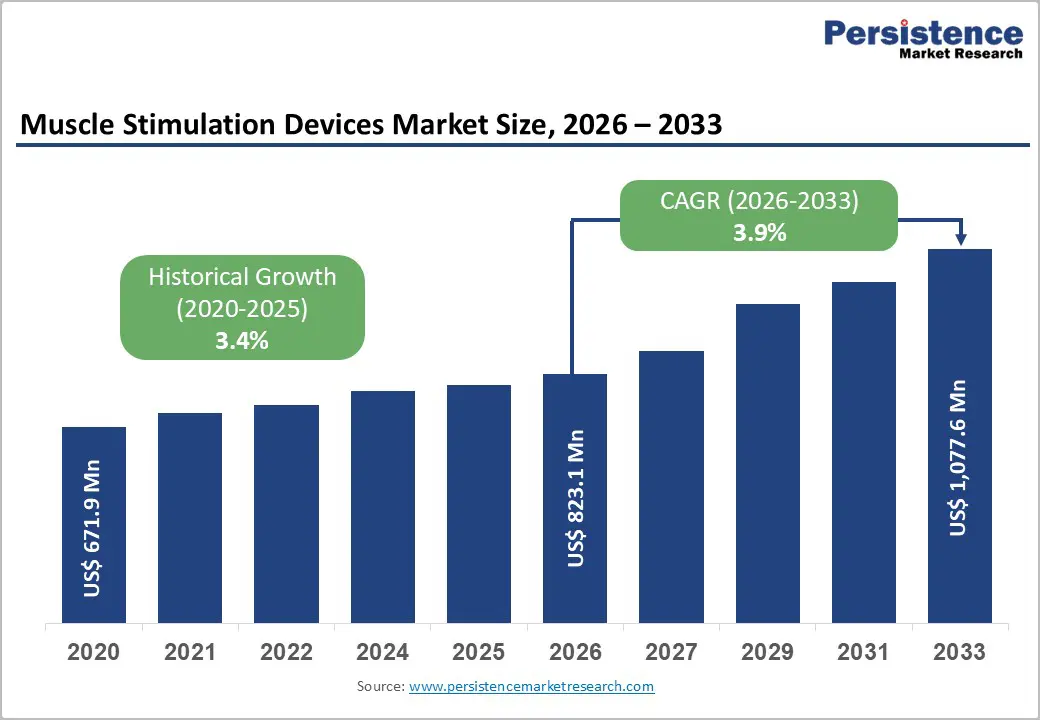
LONDON, UNITED KINGDOM, February 23, 2026 /EINPresswire.com/ -- The global muscle stimulation devices market is projected to be valued at US$ 823.1 million in 2026 and reach US$ 1,077.6 million by 2033, registering a CAGR of 3.9% during the forecast period. Growth is primarily driven by the rising burden of musculoskeletal disorders, increasing preference for non-invasive pain management, and expanding rehabilitation needs among aging populations. Technological innovation in portable and wireless systems is strengthening home-based therapy adoption, while sports-related injuries are accelerating demand across physiotherapy and orthopedic settings.
Download Your Free Sample & Explore Key Insights: https://www.persistencemarketresearch.com/samples/33861
Market Dynamics
Driver: Rising Prevalence of Musculoskeletal Disorders
The growing incidence of musculoskeletal disorders such as chronic back pain, osteoarthritis, and rheumatoid arthritis significantly contributes to market expansion. Sedentary lifestyles, obesity, prolonged desk work, and aging demographics have increased the global patient pool. Muscle stimulation devices, particularly Transcutaneous Electrical Nerve Stimulation and Neuromuscular Electrical Stimulation systems, provide non-invasive therapy by stimulating muscle contractions, improving circulation, preventing atrophy, and reducing pain signals.
Driver: Surge in Sports Injuries and Rehabilitation Needs
Rising participation in professional sports, recreational fitness, and high-intensity training has elevated injury rates globally. Muscle strains, ligament tears, and post-operative weakness following orthopedic surgeries require structured rehabilitation. NMES devices are widely adopted in sports medicine to accelerate muscle re-education, restore strength, and prevent disuse atrophy. Sports clinics and physiotherapy centers incorporate stimulation therapy alongside conventional exercise programs to optimize neuromuscular activation.
Restraint: Stringent Regulatory Approvals
Regulatory scrutiny remains a major constraint for manufacturers. Authorities require comprehensive clinical validation to ensure device safety, efficacy, and performance consistency. Concerns regarding electrical overstimulation, improper electrode placement, and unsupervised home use lead to strict labeling and post-market monitoring requirements. Approval timelines can delay commercialization of advanced wireless and app-enabled devices. Smaller firms face higher compliance burdens, limiting product diversification despite rising demand.
Restraint: High Device Costs and Alternatives
Advanced programmable and multi-channel stimulators often involve significant upfront costs. Limited reimbursement coverage in several regions increases out-of-pocket expenses, restricting accessibility in cost-sensitive markets. Patients may opt for manual physiotherapy, oral analgesics, or exercise regimens instead. Additionally, effective usage frequently requires professional supervision, adding to overall treatment expenditure. These financial and practical barriers moderate adoption rates in developing healthcare systems.
Opportunities
Expansion into Home Care Settings
Healthcare systems are shifting toward patient-centric and home-based rehabilitation models. Portable TENS and NMES devices allow individuals to manage chronic pain and post-operative recovery independently, reducing hospital visits and overall care costs. Aging populations and rising chronic disease prevalence reinforce sustained home-use demand. Manufacturers are prioritizing compact, user-friendly designs with preset therapy modes to enhance adherence and safety.
Advancements in Portable and Wireless Technologies
Technological innovation is transforming treatment flexibility and personalization. Wireless connectivity, smartphone integration, and programmable protocols enable tailored therapy plans. Clinicians can monitor compliance and adjust parameters remotely, improving therapeutic outcomes. Next-generation NMES systems offer enhanced muscle activation accuracy, benefiting neurological and post-injury rehabilitation.
Get Custom Insights Designed for Your Business: https://www.persistencemarketresearch.com/request-customization/33861
Category-wise Analysis
Product Type Insights
Transcutaneous Electrical Nerve Stimulation devices dominate the market, accounting for nearly 38% share in 2025. Their widespread use in acute and chronic pain management across hospitals and home settings supports leadership. Proven clinical validation, affordability, and portability reinforce patient and physician preference. Long-standing regulatory approvals and integration into physiotherapy standards sustain adoption as a first-line non-invasive pain therapy. Meanwhile, NMES represents the fastest-growing segment, driven by expanding sports rehabilitation and post-surgical recovery applications supported by wireless advancements.
End-user Insights
Hospitals hold the largest market share due to advanced infrastructure and high patient volumes. These facilities manage complex musculoskeletal and neurological cases requiring structured rehabilitation programs. Access to skilled physiotherapists and multi-channel stimulation systems ensures accurate therapy delivery. Hospitals also serve as early adopters of advanced technologies due to stronger capital resources and compliance capabilities, reinforcing their leading position in market utilization.
Regional Insights
North America Muscle Stimulation Devices Market
North America accounts for approximately 41% of global revenue in 2025. The United States drives regional growth through high chronic pain prevalence, advanced rehabilitation infrastructure, and strong regulatory support from the U.S. Food and Drug Administration. Favorable reimbursement policies, significant healthcare expenditure, and early technology adoption contribute to sustained demand. Growing geriatric populations and rising sports participation further strengthen market expansion, alongside increasing uptake of home-use wireless devices.
Asia Pacific Muscle Stimulation Devices Market
Asia Pacific is the fastest-growing regional market, supported by healthcare infrastructure development across China, Japan, India, and Southeast Asia. Rapid urbanization and sedentary lifestyles are increasing musculoskeletal disorder incidence. Expanding local manufacturing capabilities improve affordability, particularly for NMES systems. Aging populations and rising awareness of non-invasive therapies accelerate adoption, positioning the region as a high-growth opportunity through 2033.
Competitive Landscape
The market demonstrates moderate concentration, with established players including DJO Global, Zynex, Neurometrix, R.S. Medical, Omron Corporation, and Beurer competing alongside emerging innovators. Companies emphasize research and development of wireless technologies, strategic acquisitions, and direct-to-consumer distribution channels to expand portfolios.
Checkout Now & Download Complete Market Report: https://www.persistencemarketresearch.com/checkout/33861
Market Segmentation
By Product Type
Neuromuscular Electric Stimulator (NMES)
Transcutaneous Electric Nerve Stimulator (TENS)
Interferential (IF)
Burst Mode Alternating Current
By Application
Pain Management
Neurological & Movement Disorder Management
Musculoskeletal Disorder Management
By End-user
Hospitals
Physiotherapy Clinics
Sports Clinics
Home Care Settings
By Regions
North America
Europe
Asia Pacific
Latin America
Middle East & Africa
Key Market Developments
In November 2025, Motive Health, Inc. announced the launch of Motive Lower Back, an FDA-cleared at-home therapy designed to address underlying muscular imbalances associated with chronic lower back pain. This development highlights the growing shift toward clinically validated, home-based muscle stimulation solutions aimed at long-term rehabilitation and pain management.
Read More Related Reports:
U.S. Retail Pharmacy Market: The U.S. retail pharmacy market is set to grow from US$670.6 billion in 2025 to US$901.4 billion by 2032, expanding at a steady CAGR of 4.3% during the forecast period.
Home Care Services Market: Global home care services market valued at US$477.4B in 2025, projected to reach US$933.4B by 2032, growing at a CAGR of 10.1% during 2025–2032.
Persistence Market Research
Persistence Market Research Pvt Ltd
+1 646-878-6329
email us here
Visit us on social media:
LinkedIn
Instagram
Facebook
YouTube
X
Legal Disclaimer:
EIN Presswire provides this news content "as is" without warranty of any kind. We do not accept any responsibility or liability for the accuracy, content, images, videos, licenses, completeness, legality, or reliability of the information contained in this article. If you have any complaints or copyright issues related to this article, kindly contact the author above.
